Posts

What do all those transistors do?

The CPU in your laptop or desktop has a lot of transistors in it.  The Core i7-6700HQ that I'm typing this on has 1.35 billion of the little guys.  Buck back in the day on of the earliest computers, ENIAC , had only 20 thousand vacuum tubes which more or less fufilled the same role as transistors do now.  So what do all those extra transistors we've added accomplish, if we were able to do useful mathematical operations with just 20,000?  Most of the increase in the speed at which we run computers, the clock rate, has come from replacing large and slow transistors with smaller and faster transistors after all. Well first, what was ENIAC doing with it's transistors?  A single transistor isn't very useful.  If you're willing to use a resistor too you can perform an operation like making an output the logical and of one input and the inverse of a second input, call it AND(A, NOT(B)).  But that circuit is a very jury rigged thing which will be slow, ...
Book Review: Radical Abundance

Eric Drexler is the person who came up with the name "nanotechnology" and is probably the one most responsible for public awareness of the idea.  After a pretty long haitus he's published a new book and I thought I'd take a look but before I get to the new book I think I should provide some history. Way back in 1986 Drexler published Engines of Creation .  In it he outlined a vision of a world remade by the ability to engineer chemicals the way we engineer widgets today, assembling them precisely using mechanical arms placing bits in position rather than waiting for the random thermal motion of molecules to bring parts into contact where they can stick.  In the book he envisioned tiny robots called assemblers constructed with atomic precision using tiny arms to assemble other devices - and also replicate themselves.  That ability to replicate could potentially be a big danger if an error in programming caused them to replicated without bound like a cancer.  Th...

The old anarchists of Iceland

A while ago I made a post on  Anarchy in History , on how most traditional societies didn't have governments as we'd understand them as some group with a monopoly on the use of force.  But just because a country exists as an anarchy doesn't mean that the people in it are anarchists.  They just have their traditions and laws and accommodations and don't hold their opinions on government as an ideology.  In the same way most people who have lived under monarchies haven't considered the alternatives in a way that would make them monarchists, you mostly find those in places like the 19th century or ancient Greece where monarchies and republics lived side by side. There is one society, though, that I think you could reasonably claim was actually anarchist.  That would be medieval Iceland.  Iceland was settled by mostly Norwegians around 900 AD.  This was around the time the famous Harald Fairhair was unifying Norway under a kingdom.  We know most of ...

Fusion optimism

Image
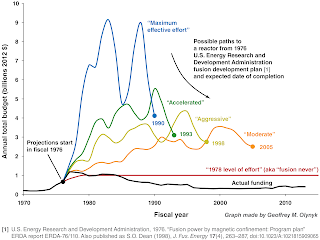
Fusion is famously the technology that's always 20 years in the future.  And because of that I hadn't really seriously considered it as a realistic solution to climate change, sustainable energy, etc.  But recently I've become more optimistic about the prospects of fusion so I thought maybe I'd explain why I've changed my views. What is fusion?  Well, it's a process that releases energy by combining elements together.  Atoms tend to resist this, so they have to be smashed together very hard in order for it to work.  In a thermonuclear bomb the fusion is triggered by a standard fission bomb going off to provide the needed energy.  Atomic weapons are rather hard to contain, though, and impractical to use as part of a power plant.  So for fusion we'd need to heat up some hydrogen very hot and keep it all together rather than expanding and escaping as very, very hot things like to do. In the Sun our star's gravity is enough to keep everything together....

Book Review: The White Man's Burder

I recently finished reading William Easterly's The White Man's Burden: Why the West's Efforts to Aid the Rest Have Done So Much Ill and So Little Good .  Reading some reviews online before starting it I was expecting it to be much more of a screed than it actually was.  Easterly criticizes the efforts of the World Bank and International Monetary Fund to further the development of poorer countries but his nuanced criticisms are in sharp contrast to most of their critics.  There's a lot of discussion about all the complicated moving parts that go into a modern commercial society, all the problems with both causing trust and causing trust to be justified between commercial actors and how people have found ad hoc  solutions in the absence of regular institutions, and how it's very hard to know in advance which interventions will actually make things better rather than just funnel money into someone's pocket.  He provides some fairly compelling statistics showin...

Waymo is getting serious

Image
First of all, in case you aren't following this sort of thing, the Uber crash I mentioned in my  last post on self driving cars  is actually a lot worse than it looked at first.  According to the NTSB report  the victim of the crash had been detected but emergency braking maneuvers are not enabled while the vehicle is under computer control, to reduce the potential for erratic vehicle behavior. The vehicle operator is relied on to intervene and take action. The system is not designed to alert the operator.  which makes me wonder if this rises to the level of criminal negligence.  Certainly there are currently no localities that are allowing Uber to test on their roads which might be the end of Uber's program. Tesla has also been in the news with some crashes involving its cars running on autopilot.  But autopilot of the sort you normally have in a boat or plane or one of Tesla's cars isn't full self driving.  The pilot or driver is suppos...

Nuclear power in space

I'm a little behind on my blogging but a couple of months ago NASA released some information on their new  Kilopower  small reactor for use in space.  So I thought this would be a good opportunity to write something about power generation in space.  Most satellites and probes in the inner solar system use solar power.  This was one of the first practical uses of solar power back when solar panels were very expensive and now that solar panels have gotten much, much cheaper it's even more of a good idea.  The solar panels on your roof are built tough and will weigh about 10 kg for every square meter or, on the Earth.  At 1300 watts of sunlight coming in times an optimistic 20% efficiency for typical solar cells you've got 26 watts per kilogram.  According to Wikipedia more expensive spacecraft-grade solar panels will give you 77 watts per kilogram, but even then the majority of the expense is going to be lifting the weight of the panel into orbit...