Posts

Copying complex adaptations

This is the followup post that I promised to write when I did my review of The Secret of Our Success .  Sorry it took so long. Well, something that occurred to me when I was reading that book was that the rate at which mutations crop up governs how fast you can change.  There's no way to develop a tolerance for lactose unless that mutation happens to occur in someone.  But the rate of mutation must also govern how complex an organism or simple society can get.  There's only so much selective pressure out there and each new mutation that isn't doing you any good requires, on average, on excess death to remove it from the gene pool.  And since each gene is an opportunity for something to go wrong in reproduction a higher rate of mutations must mean a smaller genome if your typical organism has the same number of offspring. The same with cultural knowledge.  If you're living in a band without economic specialization and people discover things by trial an...

Outgroups and colonialism

I'm currently reading The Birth of the Modern  and the sections on colonialism in South East Asia.  It had always puzzled me just how that worked.  It's one thing for the Spanish to just come into the Caribbean and be able to dominate the inhabitants by main force.  But when expanding into state societies Europeans were usually outgunned until the mid 19th century, at least on land.  There's no way that Cortez could have conquered Mexico without local allies.  And you could say that same for European colonies through Asia.  The Pilgrims, in fact, wouldn't have survived with the explicit generosity of the Native Americans. I think the best explanation from this is probably a thing Scott Alexander mentions in I Can Tolerate Anything Except the Outgroup :  Freud spoke of  the narcissism of small differences , saying that “it is precisely communities with adjoining territories, and related to each other in other ways as well, who are engage...

AlphaGo's Confidence

I'm sure those of you who follow this sort of thing know that Google's Go playing AI named AlphaGo beat the highest ranked human player last night.  There are still another four games between the two of them but I came across something in an  article  that I thought was particularly interesting. For me, the key moment came when I saw Hassabis passing his iPhone to other Google executives in our VIP room, some three hours into the game. From their smiles, you knew straight away that they were pretty sure they were winning – although the experts providing live public commentary on the match weren’t clear on the matter, and remained confused up to the end of the game just before Lee resigned. Either AlphaGo has a badly calibrated sense of confidence or it's a lot better at evaluating boards than the people watching are.  I'm looking forward to seeing how the other games turn out and whether AlphaGo's sense of how it's doing turns out to be accurate. Also, ...

RightHand Robotics

Image
As many of you know I switched jobs recently.  I'd been working at Vecna for three years and while I loved my work and my coworkers I wasn't as happy with the way the company was run.  When I was on the west coast this last summer for Ross Hatton's wedding I ran into Lael Odhner who I knew from MIT.  One thing led to another and a while later I had joined RightHand Robotics. What does RightHand Robotics do?  Well, as you might guess from the name we work with robotic grasping.  If you go to  our webpage  you can see a bunch of videos with our robotic hands doing things.  I'll just embed this one video of the hand we make picking up and moving a bunch of different objects. The arm you see there is a relatively off the shelf model made by  Universal Robots , the UR5.  The hand at the end was made by us and is called the Reflex gripper. The Reflex grippers are actually open source.  On Github you can go to  this  re...

January Links

Image
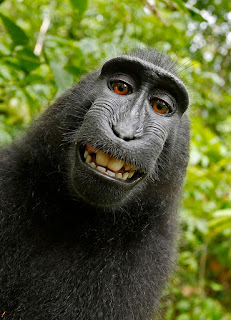
You might have heard of the  famous self-photographing monkey  shown below.  Well, there was a bit of a to do regarding who owns the copyright to the photo.  The person who owned the camera thinks he owns the copyright for some reason but there was also a group that went to court hoping to have the copyright assigned to monkey.  Well, it seems that as everybody expected monkeys  can't own copyrights .   While I'm experimenting with putting images in blog posts here's a git of the heliocentric and geocentric models of the solar system.  You can see that the planets would have had to have moved in really weird ways in order to explain their apparent position.  On the other hand at the time of Galileo people had been adding so many corrective terms or epicycles  to the geocentric model that it explained observations very well.  Kepler would eventually figure out that planets moved in  ellipses  but when heliocentrists...

Book Review: The Secret of Our Success

Joseph Henrich begins his preface to The Secret of Our Success  by going over how his path through academia led him to write this book.  He started out getting dual bachelor degrees in anthropology and  aerospace engineering.  He worked as an engineer for a while before going back to school for his doctorate in anthropology.  Luckily the math from his engineering background came in useful when he got interested in evolution, population genetics, and how the tools from population genetics could be applied to cultural transmission.  I don't think this book could have been written by someone without such a broad background. It's easy to do a bad job talking about how evolution has influenced human behavior.  It's easy to find people bloviating with evolutionary explanations about the ways men and women act differently in our society.  But clearly you won't come to any success if the supposed human universal you're trying to explain is particular...

December Links

The idea of a  Basic Universal Income  has been talked about for a long time and has gotten support from such diverse sources as  Milton Friedman  and the  Pirate Party .  The idea is that everybody basically gets money from the government every month.  If that's less than they would have paid in taxes then their taxes are reduced but otherwise they get a check.  The problem with our current system is that its possible for someone making $20k a year to lose more than $10,000 in benefits if they get a raise to $30k a year though it isn't common.  What is common is that they face a very high effective marginal tax rate on that extra $10k and the poor and rich tend to be the most likely to change their behavior in response to tax rates since the poor have more opportunities to save money by doing things other than working and the rich are making enough anyways.  And unlike salaried middle class employees poor people usually have hourly wage...